|
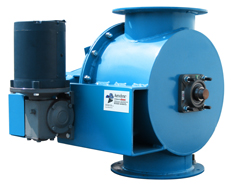
Aerodyne Rhino Rotary R Valve™
The Aerodyne Rhino Rotary "R" Valve is designed for continuous discharge of dry, free-flowing, low-abrasive solids in gravity flow or low-pressure systems. Widely used in applications such as the bottom of cyclonic dust collectors and baghouse hoppers, the Rhino Rotary "R" Valve's steel plate construction gives it a distinct advantage in quality, flexibility and durability over cast valves.
- Heavy duty steel plate fabrication.
- Shrouded rotor.
- Neoprene rubber tips.
- Can handle temperatures to 175°.
- Stainless steel optional.
- Available with TEFC or Explosion proof
motor.
- Operates under vacuum or pressure.
- Custom sizes available
 |
 |
Aerodyne Rhino Rotary H Valve™
The Aerodyne Rhino Rotary "H" Valve's cast iron construction and tight tolerances
provide exceptional performance in handling highly-abrasive materials when compared to competing cast valves.
Hardened-surface rotor vane tips and added clearance outside the rotor shroud allow the rotary "H" Valve to
operate smoothly without packing or excessive wear. This tough material handling valve is equipped with a
standard 4 vane rotor, outboard bearings for easy maintenance, and a TEFC motor.
The Aerodyne Rhino Rotary "H" Valve acts as a rotary airlock feeder and suits a wide range of applications in industries
where dry free-flowing powders, granules, crystals, or pellets are used. The "H" Valve easily handles cement, ore, sugar, minerals,
grains, plastics, dust, fly ash, flour, lime, coffee, cereals, pharmaceuticals, and more. This rugged and dependable valve is ideal
for nearly any abrasive material application.
- Cast iron construction
- Shrouded rotor
- Abrasive resistant
- Hardened-Tip Steel Rotor
- Custom sizes available
Rotary Valve Applications
A rotary valve, also called a rotary airlock valve, is used in a dry material handling system to control the feed or discharge of free-flowing bulk material without compromising the negative or positive air pressure used in the system.
Its design is similar to a revolving door by which one might enter a building: material must pass through a rotating chamber in order to reach the opening on the other side. The turning vanes of the valve are tightly spaced to the valve walls, creating an airlock. Vanes may be tipped with hardened metal or flexible wipers. A
rotary valve is motor driven; the motor and its controls must be part of the specification.
Common applications for rotary valves include pneumatic conveying, gravity conveying, gravity discharging, and volumetric metering.
With these applications, they are commonly used with bag house hoppers,
storage bins, and dust collection systems.
The seal of a rotary valve is not perfect and is therefore suited to low and moderately pressurized systems where a small air leak is acceptable. Its design is compatible with high temperature applications, and models are available for this purpose. Heavy duty rotary valves, such as Aerodyne's Rhino Rotary H Valve™, are available that can process abrasive and stringy materials.

|