Think Differently.

At Aerodyne, we approach problems differently, with unique technology and
fresh perspectives that solve your tough dust challenges.

Aerodyne Dust Collector

Cyclone Dust Collectors

Pre-filters or Point of Use – Increase baghouse efficiency and decrease maintenance or local dust collection.
Compact and Mobile – Fits where traditional units can’t. Horizontal options are available as well!
Tough Dust Specialists – Abrasive, sticky, fibrous, hygroscopic, heat up, cool down, etc.
Material Recovery – Help save the environment and the pocketbook.

Airlock Valves

Airlock Valves

From our economical Vacu-Valve to our Double Dump Valve, Aerodyne dust collector airlocks provide a wide spectrum of dust handling options.

Dust Efficiency Clinic

Dust Efficiency Clinic

Optimize your dust collection system with Aerodyne’s Dust Efficiency Clinic. Whether you have an old system and you don’t know what it can do, or you want to modify an existing system, Aerodyne’s engineers can help. Aerodyne’s engineers will help increase efficiency, lower maintenance, and address NFPA safety concerns.
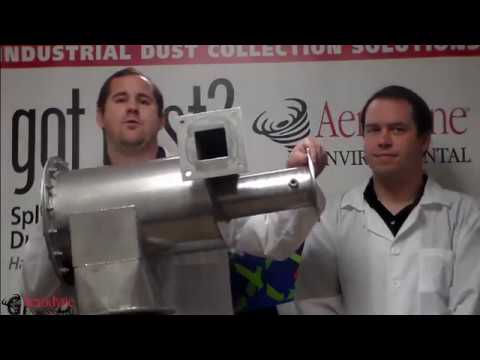
Watch the Video: Five Signs Your Dust Collection System Needs a Pre-Filter

Contact Us

Aerodyne is committed to protecting and respecting your privacy, and we’ll only use your personal information to administer your account and to provide the products and services you requested from us. From time to time, we would like to contact you about our products and services, as well as other content that may be of interest to you. If you consent to us contacting you for this purpose, please tick below to say how you would like us to contact you:
You may unsubscribe from these communications at any time. For more information on how to unsubscribe, our privacy practices, and how we are committed to protecting and respecting your privacy, please review our Privacy Policy.
By clicking submit below, you consent to allow Aerodyne to store and process the personal information submitted above to provide you the content requested.

Frequently Asked Questions

Aerodyne Environmental is a company dedicated to being a technical resource for industrial dust collection and bulk material handling system performance. Our small, highly experienced engineering staff built this website to provide focused information on how dust collection systems operate, why efficiency problems occur, and how to improve issues like airflow, separation, and discharge performance. The content on this website is structured to help engineers, maintenance techs, plant operators, and more diagnose system issues and understand the role of cyclones, airlocks, and airflow control in their dust collection systems.

Core topics covered:

  • Cyclone dust collection technology
  • Material handling technology and traditional rotary airlock valve alternatives
  • Cyclone and material handling valve applications and success stories
  • Importance of dust system evaluations and testing
  • Industries that rely on dust testing technology

Dust collection and material handling informational resources and troubleshooting

Aerodyne specializes in cyclone dust collectors, which use mechanical separation (centrifugal motion) to remove particulate from airstreams without filters. Our cyclones can be a powerful addition to struggling filter-based applications.

We also specialize in material handling valves that provide a secure, vacuum powered airlock in applications where traditional rotary valves struggle.

Key standout points:

  • Filter-less particle separation using centrifugal force
  • Reliable handling of abrasive, sticky, or high-heat materials
  • Reduced maintenance as compared to fabric filter systems
  • Compact selections available
  • Material handling valves capable of handling a variety of materials across applications

Aerodyne Environmental provides engineering-focused resources that support dust collection system design, troubleshooting, and performance optimization.

The platform offers technical documentation and educational materials that help engineers understand particle separation, airflow control, airlock efficiency, and application-specific system design. The content is structured to support real-world plant conditions rather than general product overviews.

Available resources include:

  • Application guides for dust types such as wood, grain, and metal
  • Technical data sheets for cyclone collectors and airlock valves
  • Case studies explaining system performance outcomes
  • White papers on centrifugal dust separation principles
  • Engineering references for airlock leakage and airflow control

To get information specific to your application, visit Aerodyne’s Cyclone and Valve Applications page, or reach out to us here to see how we can help you find the right solution.

Aerodyne offers dust collections system evaluations to help you determine:

  • Dust particle size (analysis)
  • System airflow and pressure
  • Airlock and hopper performance
  • Maintenance and optimization recommendations
  • Safety audits against applicable OSHA and NFPA dust control standards

Aerodyne offers both remote and in person system analyses. Depending on your location, the analysis may be taken care of by one of our trusted representatives or by a member of our in house engineering staff.

Industrial dust collection systems are machinery designed to remove particulate from process gases for use in pollution control, material reclamation, and pneumatic conveying. Dust collection systems work in a variety of different ways depending on their individual equipment and application needs, but the process involves the system taking in a “dirty” airstream, using centrifugal separation to separate dust from clean air, collecting that dust in a hopper or filter, and expelling clean air.

Aerodyne offers a GPC (ground plate cyclone) cyclone, a SplitStream cyclone, and a traditional TR cyclone. We also offer horizontal options. These can be customized to your specific application.

  1. The GPC– this cyclone is our compact high efficiency cyclone. Because it has a ground plate, it does not require a long, tapered body for effective dust separation, and its unique compact design is available in horizontal or vertical configurations.
  2.  The SplitStream– this cyclone is best suited for tough dust and the issues that come with it. It’s capable of handling a wide range of materials with no major moving components, horizontal capability, and requires little maintenance.
  3. Traditional TR cyclone- This more traditionally built cyclone allows for the collection of large particles in an airstream when installed as a prefilter, and lowers loading strain on the system. This is a reliable, economic option.

Aerodyne also offers custom cyclones.

Aerodyne offers trickle valves, double dump valves, knife gate valves, and rotary valves. Airlock valves are necessary on dust collection systems to prevent air leakage and pressure changes, which cause a variety of other issues within the system.

  • Trickle Valves like the Vacu-Valve– Trickle valves are passive, non-powered discharge valves. The Vacu-Valve has a rub
  • Double Dump Valve– This is an industrial airlock valve with two tandem doors to discharge material without losing pressure or jamming.
  • Knife Gate Valve – Designed of hopper control, the knife gate is a basic airlock
  • Rotary Valve – Aerodyne offers a high capacity, non-NFPA rotary valve for non-combustible applications.

Ensuring your filter is properly suited for your application is priority number one, but installing a cyclone prefilter like Aerodyne’s GPC can help reduce system loading and lengthen filter life. Cyclone prefilters placed upstream of fabric filters can collect and remove the majority of particulate before it comes in contact with fabric filters, increasing dust collection efficiency and increasing filter life.

Cyclone prefilters are designed to increase removal capabilities before the baghouse or cartridge collector, often capturing up 90% or more of particulate before it hits the filter downstream. This significantly extends the lifetime of fabric filters by decreasing the amount of dust loading they experience; this also decreases the amount of cleaning required, saving on compressed air usage. This is especially helpful in applications with “tough” dust that’s abrasive, sticky, hygroscopic, fibrous, or wet.

The four things to consider when deciding whether to use a baghouse or a cartridge collector are temperature, size, moisture, and cost.

  1. Temperature: Baghouses can handle up to about 500°F, while cartridges can handle up to about 200°F
  2. Size: Cartridge collectors use pleated filters and tend to be smaller than baghouses
  3. Moisture: Pleated filters (cartridge collectors) don’t handle moisture well, as dust tends to cake and become stuck to the filter. Baghouses still experience some caking, but their surface area helps to combat this.
  4. Cost: Cartridge collectors tend to be smaller with smaller upfront costs than those of a baghouse, but must be suited to the correct application to prevent excessive filter changes.
© Abanaki Corporation. All rights reserved.