
What factors affect the removal efficiency of dust collectors?
In addition to dust type, several physical properties strongly influence collector performance and technology selection.
What are the different types of dust?
Not all dust behaves the same, and its characteristics play a critical role in determining how it should be collected and handled. Many materials fall into more than one category, and each category may require specific design considerations to ensure safe, efficient, and reliable operation. The following classifications represent some of the most common dust types encountered in industrial applications.
Combustible vs. Non-Combustible
Any material that can oxidize is considered combustible. Many everyday materials—wood, plastics, metals, and food products—can produce combustible dust when processed industrially. When combustible dust is present, dust collection systems must be designed with appropriate safeguards to prevent or contain fires. Regular inspection and housekeeping are also essential, as combustible dust that escapes collection can accumulate and increase risk. NFPA standards specifically address combustible dust, and OSHA continues to place increased emphasis on its management.
Combustible dust examples: wood dust, paper pulp, flour, sugar, zinc powder
Non-combustible dust examples: silicon dioxide (silica), sodium bicarbonate (baking soda), glass dust
Explosive vs. Non-Explosive
All explosive dust is combustible, but not all combustible dust is explosive. NFPA defines explosive dust and provides standardized test methods, including the 20-liter and 1 m³ chamber tests to evaluate explosibility. Test results determine whether explosion protection is required and provide key parameters such as Kst and Pmax for system design. Several points are critical when evaluating explosive dust:
- NFPA requires a Dust Hazard Analysis (DHA) for each application, updated every five years or when process changes occur.
- Historical operation without an incident does not guarantee a material is non-explosive.
- In general, smaller particles are more likely to be explosive, as fine dust can remain suspended in air and form an ignitable cloud.
Explosive dust examples: grain, wheat, and corn dust, sawdust, starches, coal dust
Non-explosive dust examples: concrete, limestone, granite dust, alumina
Abrasives
Abrasive dust accelerates wear on dust collectors, ductwork, fans, and valves. Equipment life depends on factors such as dust concentration, conveying velocity, and materials of construction. Cyclones and other mechanical separators can help reduce erosion, while specialized materials such as AR steel, alloys, and protective coatings can significantly extend service life. Systems handling abrasive dust typically require increased inspection and maintenance.
Visit our abrasives industry page here.
Abrasive dust examples: silica dust, sands, metal and mineral powders, coal dust
Fibrous
Fibrous dust consists of long, string-like particles that are often light and difficult to handle. These materials can behave unpredictably in airflow, sometimes passing through collectors depending on particle orientation. Fibrous dust may also wrap around internal components or discharge devices, creating plugging or mechanical issues, particularly in rotary valves.
Fibrous dust examples: fiberglass, rockwool, glass filaments
Hygroscopic and Sticky
Hygroscopic dust absorbs moisture and may become sticky, which can lead to buildup and reduced performance. Outdoor installations, seasonal weather conditions, and compressed air cleaning systems can introduce moisture that exacerbates these issues. Sticky or moisture laden dust can blind filters, restrict airflow, and increase maintenance requirements.
Hygroscopic and sticky dust examples: sugar, cement powders, fertilizers, starches, flours
Friable
Friable materials easily break apart during handling. When the collected dust is a product rather than a waste stream, excessive breakage can be problematic. Collector selection and operating conditions must be carefully considered to minimize material degradation.
Friable dust examples: dry crystalline silica, fiberglass, rock wool, drywall dust, flours, starches, refined sugar, powdered milk
Agglomerating
Agglomerating dust tends to clump together, forming larger particles. While this can improve capture efficiency, it may also cause plugging in filters, airlocks, or hoppers. Agglomeration can also create misleading test results, as dust may behave differently at the point of generation than it does after clumping occurs downstream.
Agglomerating dust examples: Paper and cellulose fibers, flours, starches, fine chemical powders and pigments, cement and lime powders
What are dust characteristics?
Particle Shape
Particle shape affects how dust behaves in an airstream. Spherical particles are the most predictable, while long, thin, or flat particles may orient themselves in ways that allow them to bypass mechanical separators or become embedded in filter media. Shape can also influence how easily dust is released during filter cleaning.
Particle Size Distribution (PSD)
Most dust streams contain a range of particle sizes. Mechanical collectors rely on momentum and centrifugal force, making them more effective on larger particles. Filter collectors capture particles across size ranges, but may experience a shorter filter life when very fine particles become embedded in the media.
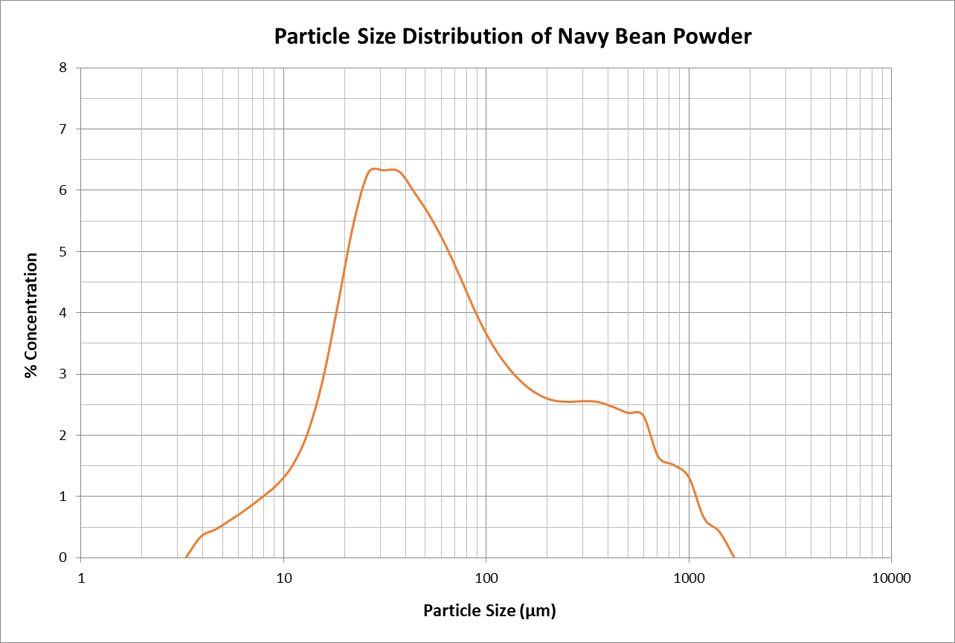
Navy Bean Particle Size Distribution Chart
Density
Material density determines how readily particles remain airborne. Higher-density dust is generally easier to remove using mechanical separation methods such as cyclones, while low density dust often requires filters. High-density materials may also increase structural loading in hoppers and discharge equipment.
An example of a high density dust might be a heavy mineral dust like tungsten carbide powders, while a lower density dust would be something like flour.
Concentration
Dust concentration significantly affects system performance. Mechanical separators often achieve higher efficiency at higher dust loadings, while fabric filters are limited by available surface area. Excessive dust concentrations can blind filters, increase pressure drop, and reduce system capacity.
Looking to get your dust tested or curious about how efficient your system is at handling it?
Aerodyne offers dust testing for removal efficiencies and particle size analysis through our in house Pilot Testing Lab.
Visit our Dust Testing Page here, or if you’d like, you can talk to an engineer about your application, 100% free of charge.